Skip to content

Services hub • scope-first • clear exclusions

Roofing services with a practical scope matrix

This page is designed as a hub: each service has an anchor section, a quick “included/not included” table, and a shared set of assessment factors and boundaries. If you’re comparing options, start with the service matrix. If you’re ready to ask for a quote, jump to enquiry or visit contacts.

Need a quick diagnostic?

See how we capture evidence and scope in About and confirm expectations in Policies.

Prefer social proof first?

Read real customer notes on Reviews and then use the matrix below to compare scope.

Service matrix (compare quickly)

Use this as a “what fits what” map. For details, jump to each section: Roof repairs, Flat roofs, Guttering. For what we can’t do (or won’t do), read Boundaries & exclusions.

Scenario / need Roof repairs Flat roof work Guttering Useful cross-links
Active leak during rainfall Primary (tiles, slates, flashing) If leak relates to flat membrane/outlets If overflow/splashback contributes Assessment factors, Urgent enquiries
Recurring damp patch with no obvious entry Likely (check junctions, valleys) Possible (edge trims, upstands) Possible (joints, fall, downpipes) Diagnostics approach, Photos & evidence
Slipped/broken tiles or slate loss Primary Not applicable Not applicable Included / not included
Ponding water on flat roof If from adjacent pitched junction Primary (outlets, detailing, minor build-ups) If outlet blockage is via downpipe Flat roof section, Preparation checklist
Overflowing gutter / staining on brickwork If water is entering via eaves If overflow affects flat roof edge Primary (cleaning, joints, alignment) Guttering section, Access policy
Buying a home: want practical condition notes Included as part of inspection scope Included as part of inspection scope Included (rainwater handling checks) Reviews, Ask for an inspection
Ongoing maintenance to reduce surprise costs Periodic checks & small preventative fixes Primary (seams, edges, outlets) Primary (clears, minor adjustments) Maintenance policy

Note: “Primary” indicates best match, not an automatic guarantee of outcome. Final scope depends on on-site assessment, access, and safe working conditions (see assessment factors and boundaries).

Illustration: pitched roof repairs with tiles, ridge, and flashing details

Roof repairs (tiles, slates, flashing)

Targeted repairs for leaks, slipped tiles/slates, damaged flashing and ridge issues, with clear scope and exclusions before work starts. We focus on finding the most likely water path, documenting what we can see, and being explicit about what may only be confirmed once a small area is safely opened.

Typical outcomes

  • Leak entry point narrowed down to a junction, broken covering, or defective detail.
  • Small section of coverings lifted and re-seated with compatible fixings where needed.
  • Flashing defects patched or re-detailed where practical (subject to access and material condition).
  • Ridge/verge defects assessed and repaired when feasible without full replacement.

When this service fits best

  • Recent storm damage: slipped tiles/slates, dislodged ridge pieces.
  • Intermittent drips near chimney breasts, valleys, or abutments.
  • Localised damp with evidence of staining on rafters or felt.
  • You want a limited repair first, with a clear path to escalation if needed.
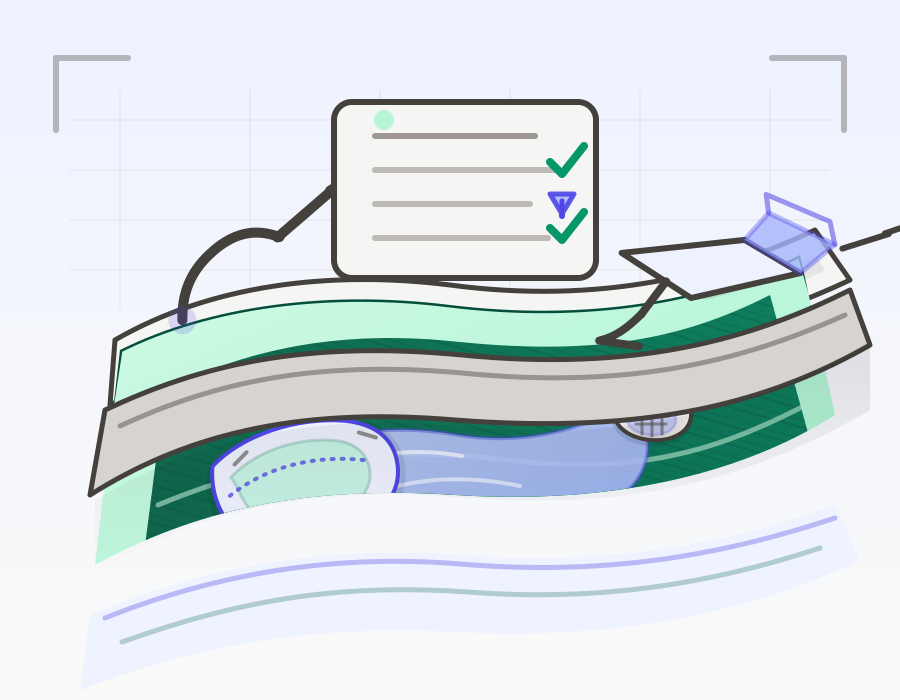
Illustration: flat roof membrane with edge trims, outlet, and fall direction arrows

Flat roof maintenance & renewal

Inspection and practical maintenance for felt/EPDM-type flat roofs, including detailing around outlets and edges to reduce water pooling risk. We prioritise detail points (outlets, upstands, corners, terminations) because many flat roof failures start there rather than in the “middle field”.

What we look at

  • Outlet performance: debris, restriction, and safe access to clear.
  • Edge trims and drips: signs of capillary tracking or wind-lift at edges.
  • Upstands/penetrations: cracks, lifting, open seams, and patch compatibility.
  • Evidence of moisture movement: staining lines, blistering, or soft spots (visual/tactile where safe).

Practical renewal (scope-led)

  • Localised patching where substrate and surrounding membrane are suitable.
  • Edge/outlet detailing improvements to reduce repeat issues.
  • Recommendations where a “patch” won’t last (e.g., widespread failure or saturated build-up).
  • Clear written notes on what is maintenance vs. renewal.
Illustration: gutter and downpipe system with water flow and joint points highlighted

Guttering & rainwater handling

Cleaning, minor repairs and alignment checks to help rainwater move away from fascias, walls and foundations; includes downpipe checks. We treat guttering as a system: it only works when the run, joints, brackets, and downpipes all cooperate.

Common causes we address

  • Debris buildup leading to overflow at back edge.
  • Misaligned fall causing standing water and staining.
  • Leaking joints due to movement, worn seals, or poor alignment.
  • Downpipe restriction at bends, gullies, or poor discharge points.

What you get

  • Clear-out and visual checks along accessible runs.
  • Notes on joints/brackets that are functional now but likely to fail later.
  • Advice on periodic maintenance intervals based on nearby trees and roof pitch.
  • Photos where useful (see photo policy).

Included / Not included (scope table)

This table is intentionally explicit. It’s not a “fine print” trick—it's a planning tool. For how we handle changes once work starts, see changes to scope.

Work item Included (typical) Not included (typical) Notes / where to read more
Site visual check & basic photos Yes, where safe and accessible Drone surveys; thermal imaging Photos policy
Minor tile/slate re-seating Often included in repair scopes Full reroof or widespread renewal Roof repairs section
Local flashing patch/detailing Yes, when material condition allows Chimney rebuild; full lead replacement by default Assessment factors
Ridge/verge defect repair Small repairs if feasible Structural ridge beam work Boundaries
Flat roof outlet clearing Yes (access permitting) Drain excavation; internal plumbing repairs Access policy
Flat roof edge/upstand patching Yes, for localised defects Guaranteed life-extension promises Terms
Gutter clearing (debris removal) Yes, common scope Deep cleaning of soffits/fascias as a cleaning service Guttering section
Gutter alignment / fall adjustment Minor bracket adjustments Full replacement of long runs as standard Changes to scope
Downpipe check and basic clearing Yes, where safely reachable Unblocking inside the home; drain rodding beyond our safe access Exclusions
Small consumables (sealant/fixings) Often included in minor repairs Large material quantities for renewals Quote structure
Waste handling (small amounts) Reasonable tidy-up of job waste Skip hire or disposal for large strip-outs Site care
Reporting (plain-language summary) Yes (what we saw, what we did, what to monitor) Formal building survey / mortgage report Documentation
Temporary water ingress reduction Where safe and feasible Open-ended “on call” standby Urgent enquiries
Work at height planning Yes (risk-based approach) Unsafe methods or rushed shortcuts Safety policy

If you’re unsure which column your request falls into, send a brief description and a couple of photos via contacts. We’ll respond with a scope summary and assumptions.

Assessment factors (what changes time & cost)

Roofing isn’t just “size of roof”. Below are the practical factors we use to assess complexity and risk before confirming scope. This also informs scheduling (see scheduling policy) and access planning (see access policy).

Factor Why it matters Examples of what we may ask for
Roof pitch & height Impacts safe access, time on ladder/scaffold, and method choice. Rough storey count; photo from street; access to rear.
Access constraints Conservatories, narrow passages, and fragile surfaces affect safe setup. Access notes + photos of rear elevation.
Covering material type Compatibility of fixings/repairs differs between concrete tiles, slates, etc. Close-up photo of a tile/slate edge and fixings if visible.
Age and prior repairs Older roofs may have brittle materials; earlier patching affects next steps. Approximate age; any invoices/photos; what was done before.
Junction complexity Chimneys, valleys, dormers increase leak pathways and detailing time. Photos of junction; interior staining location (room/ceiling).
Weather window Some adhesives/sealants and membrane work require dry conditions. Flexibility in dates; urgency level (active leak vs. monitoring).
Extent of water ingress Widespread damp may indicate multiple entry points or prolonged exposure. Photos of staining; when it appears; rainfall/wind direction correlation.
Substrate condition (flat roofs) Soft spots or saturated build-up can make patch-only approaches unsuitable. Any known deck issues; where ponding occurs; outlet position.
Rainwater system continuity Gutters work only if downpipes discharge correctly and aren’t restricted. Where downpipe discharges (gully/soakaway); overflow locations.
Neighbour boundaries & shared elements Terraces and shared gutters may require coordination and permissions. Is it a mid-terrace/end-terrace? Photos of party wall gutters.
Working hours / noise constraints Affects scheduling and duration planning in dense neighbourhoods. Preferred hours; any building rules; tenant/landlord contacts if relevant.
Next step: send details via contacts. For how we store enquiry information, see privacy.

Boundaries & exclusions (clear limits)

These boundaries help keep work safe, legal, and predictable. If something falls outside scope, we’ll say so early and point you to the right next step. Also review Terms and Safety policy.

  • Structural engineering fixes are not provided (e.g., rafters, trusses, chimney rebuilds).
  • Interior remedial works (plastering, decorating, mould treatment) are excluded.
  • Electrical work (including bathroom extractor rewires, exterior lighting) is excluded.
  • Drain excavation/underground drainage repairs are excluded (we can flag likely issues).
  • Unsafe access conditions: we won’t work where safe setup isn’t possible (see access).
  • Asbestos handling: we do not remove or disturb asbestos materials; specialist handling required.
  • Third-party damage (pre-existing brittle coverings, hidden defects) may limit repair outcomes; we document and discuss options.
  • Unbounded “find and fix anything” requests: we work to an agreed scope and change control (see scope changes).
  • Guaranteed future performance cannot be promised for limited repairs on aged systems; we focus on practical risk reduction and evidence.

If your request might fall outside scope

Send an enquiry anyway. We’ll answer clearly and may suggest the right type of contractor or inspection path. Use contacts and include photos.

How we handle uncertainty

Some defects are only visible after carefully lifting a small area. We agree assumptions up-front and confirm changes before continuing. Details: quotes and changes.

Preparation checklist (helps us work safely)

Preparing a few items ahead of time can reduce delays and make the visit more productive. If you can’t do something on the list, tell us in your enquiry—no problem. For arrival windows and rescheduling due to weather, see scheduling.

1) Share your best contact number and confirm address details (including postcode).
2) Note when the issue occurs (heavy rain, wind direction, only after long rain, etc.).
3) Take wide and close-up photos (roofline, gutter run, interior stain). Include one “context” photo.
4) Clear fragile items near access points (garden furniture, pots, ornaments) if you can.
5) If there’s a leak indoors, place a container/towel and move valuables away from the area.
6) Provide parking/loading info: permits, narrow streets, time restrictions.
7) Tell us about access constraints (conservatory below, shared alley, steep steps).
8) If you’re a tenant, confirm landlord permission for inspection/repairs.
9) If pets are present, plan to keep them safely inside during access and ladder movement.
10) Point out any known hazards (loose paving, unstable sheds, fragile roofs on extensions).
11) If possible, identify the internal location under the suspected defect (room, corner, near chimney breast).
12) Have any previous paperwork ready (older quotes, repair invoices, warranties, photos).
13) If you have a flat roof, note where the outlet is and whether it connects to a downpipe or internal drain.
14) If guttering overflows, mark the overflow point with a photo after rainfall (safe distance only).

Service enquiry (mailto)

This form opens your email client using mailto: and includes a structured subject/body for faster triage. Please avoid sharing sensitive personal information. For details, see privacy.

Tip: If you have photos, mention “photos available” and we’ll suggest the easiest way to share them after first contact. For expectations around documentation and follow-up, read photos and quotes.

By contacting us you acknowledge our terms and privacy notice.

Contact details

Address
18 Kingsway Mews, Manchester M1 1AD
Hours
Mon–Fri 08:00–18:00
Sat 09:00–13:00
Sun Closed

If you’re comparing options

Re-check the service matrix, then review included/not included and assessment factors before sending an enquiry.